
Truck, Controller, Line: What You Actually Need to Know Before You Drive
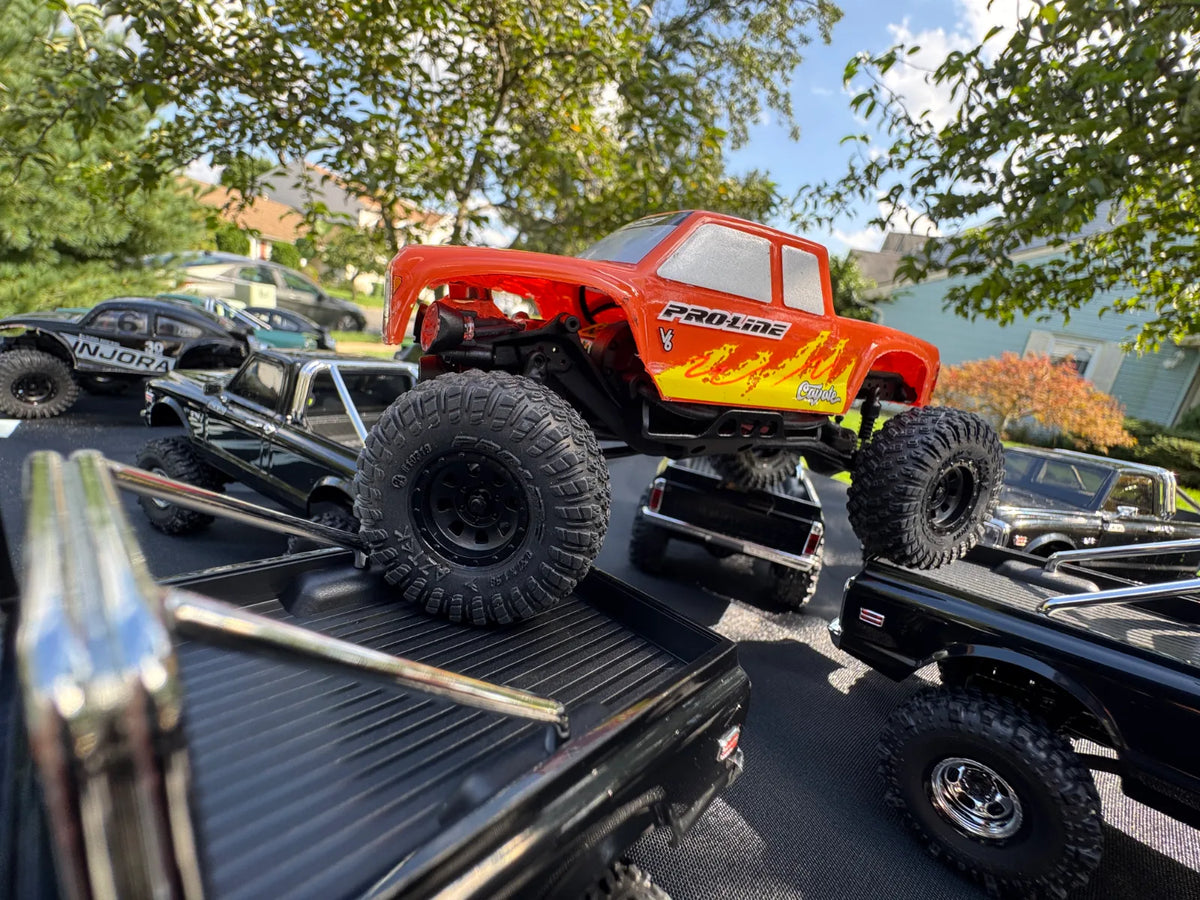
Most people pick up a controller at one of our events and immediately mash the throttle. Truck rears up, climbs sideways, flops on its roof. Everybody laughs. Fine — that's part of it.
But if you want to be the kid who clears the canyon on the first attempt while everyone else is flipping, here's what's going on under your thumbs. Four parts. None of it complicated.
The truck
Ours are 1/30th scale on the viral Axial SCX-30 4x4 platform, built up with custom suspension, aftermarket Pro-Line Black Clobber wheels and oversized Aztek tires, running an extended, heavier 400mAh battery. Small words, real reasons.
The motor doesn't want to be fast. On rock, fast is the enemy. What you want is low-speed torque — the ability to turn the wheels slowly and steadily against a ledge without stalling out or launching. Crawling is a slow sport. The motor is set up to creep.
The steering servo is the little motor that turns the front wheels. On a rock, you're almost never going dead straight. You are constantly making tiny corrections — a hair left to keep a front tire on a high edge, a hair right so the rear doesn't drop into a crack. A crisp servo means those corrections happen the instant you ask for them.
Suspension is the part people underestimate. A crawler's job is to keep all four tires touching something. If a wheel lifts off, it spins uselessly and you've just lost a quarter of your grip. Soft, long-travel suspension lets each corner droop down into holes and compress over bumps so the chassis stays planted while the terrain moves underneath.
Tires do the rest. Oversized, soft and grippy, so they deform around the rock instead of skating off it. That heavier battery isn't only about run time either — weight down low keeps the truck from tipping when you're leaned over on a side hill.
The controller
Two channels. That's genuinely it.
One channel is throttle: forward and reverse. One channel is steering: left and right. No gears, no brake pedal, no handbrake, no buttons you need to memorize. If you have ever pushed a shopping cart, you have the hardware.
The whole skill of this sport lives in how gently you use those two inputs. That's the entire game. Our operators hand you the controller, show you the two sticks, and you're driving in about fifteen seconds. Then we spend the rest of the rotation coaching the part that actually matters.
Reading a line
A line is the route your truck takes through an obstacle. Good drivers pick the line before they touch the throttle.
So stop. Look at the rock. Ask three things. Where do my front tires make contact — on a flat face, or on a sharp edge that'll deflect me? Where does the truck tip over if I get this wrong, and can I approach from an angle that keeps me more upright? And what happens after the ledge — is there a drop, a gap, a rope bridge waiting?
Then aim for contact. You want the tires meeting the rock square, not glancing off a corner. Usually the smart line isn't the shortest one. Going around the tall ledge and up the ramp beside it is not cheating. It's driving.
Watch the person ahead of you too. Free information. If three drivers in a row flip in the same spot, do not go to that spot.
The one mistake everybody makes
Too much throttle.
That's it. That's the big one. When a truck refuses to climb, the instinct is to give it more. More throttle on rock does three things, all bad: it unloads the front wheels so the truck wheelies and tips backward, it lets the tires spin instead of grip, and it takes the decision away from you before you can correct.
The fix is boring and it works. Feather it. Small, steady inputs. If a wheel is spinning, back off — don't add. If you're stuck, reverse a few inches, change your angle, and come at it again. A truck that's moving slowly is a truck you can still steer. A truck that's airborne is just a passenger.
Nobody learns this from a blog post alone. You learn it with a controller in your hand and somebody standing next to you saying "ease off, ease off, there you go." That's what our crew does — we run the rotations, coach the drivers and keep it moving, so you're a guest at your own event.
If there's a birthday coming and you want the kid who just read all this to get a real go at it, start here: https://www.crawlermadness.com/pages/birthdays. Tell us your space and we'll tell you which setup fits — the Crawler Zone Party drops into a compact footprint in a yard or party room, and it's the one Dad is not skipping.
